A grand old cinema in Sydney, the Ritz in Randwick, is celebrating its 85 yr anniversary, and to mark that milestone they’re screening a bunch of classic Aussie movies.
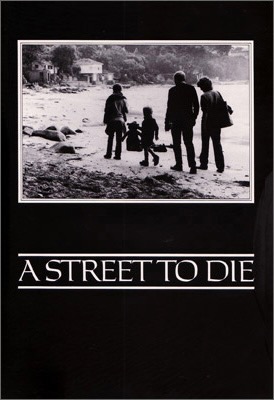
One of the films they’ve selected to screen is my very first feature film, A Street to Die, which I made in 1983-84. I was 30 yrs old when I made that movie.
I thought I’d give you the story behind the movie, and how it got made ~
~~~~~~~~~~~~~~~~~~~~~~~~~~~~~~~~~~~~~~~~~~~~~~~~~~~~~~~
A Street to Die was my first feature film which I began to make in 1983. I’d been married to Jennifer Cluff for a year, and Jennifer had just given birth to a beautiful little girl, Nellie. I’d set myself up as an independent producer a year earlier, and had made two 50 minute dramatised documentaries, one of which had just won the Sydney Film Festival Award for Best Documentary. Both films had been picked up on completion by the ABC and the BBC.
Prior to making those two films, I’d spent ten years at the ABC where I trained as a journalist, then I moved into current affairs as a reporter/producer (This Day Tonight and Four Corners), and from there I moved into producing and directing documentaries for the ABC’s flagship show, A Big Country.
I’d wanted to move into drama for sometime, because I found documentary very limiting. I tended to want to mess with reality, which is a big no-no in documentary. So while making docos I took up acting classes, to learn how to direct actors. I felt that was essential if I was to become a feature film director. More on that later.
I remember one Saturday morning, I was having breakfast and reading The Weekend Australian. There was a front page story about a street in the western suburbs of Sydney that had housing for war service veterans.
What was remarkable about this street was that on one side there were houses for Korean veterans, and on the other side was housing for Vietnam veterans. The front page story was largely taken up with an aerial photograph of the street, showing that almost every house on the Vietnam veterans’ side had major health problems – cancers, miscarriages, suicides, respiratory issues – yet there were no really serious medical issues on the Korean side.
The story featured a piece about Colin Simpson, a Vietnam vet who had come down with Lymphoma which he believed was caused through his exposure to Agent Orange. Colin Simpson had been a forward reconnaissance soldier, and he often went behind enemy lines into areas that had recently been defoliated by Agent Orange. On several occasions, he was actually in the jungle when planes flew overhead and dropped Agent Orange onto the foliage in which he was hiding – soaking him.
The newspaper story was about how Colin Simpson, who worked as a printer at one of the big newspaper conglomerates, decided to take on the Federal Government because he believed that there was a causal link between his cancer and his exposure to Agent Orange.
At the time, no Government involved in the Vietnam War had acknowledged culpability for their use of the deadly chemical.
Colin Simpson, a working class bloke, threw himself into detailed research and took the Government to court. He was knocked back two times but repeatedly appealed, and he died before the third appeal was heard. His wife took that third appeal to court and subsequently won – and it was the first time that a government had been forced to acknowledge a link between the death of a veteran and their military’s use of Agent Orange.
It became a major precedent case around the world.
So I read this remarkable story while having my brekkie and it really stirred a fire in me. I thought immediately that there was a film in it. This was a story that had to be told on a wider canvas. So I sent a researcher out to the street to spend time with Colin Simpson‘s wife. After three weeks the researcher came back and said: You must do this film.
Over the next several months I worked very closely with Colin Simpson‘s wife on the writing of the script. She had script approval at every stage. And she even decided to allow us to shoot the film in her actual house.
First though, I had to get the film together. I had to cast, and then I had to raise the money. I wasn’t prepared to go to a producer – I knew from past experience that they’d just dick around and juggle my precious project with several others, and I’d spend years waiting for them to pull it together, if indeed they ever would. So I decided to produce it myself. After all, I’d just written, produced and directed two 50 minute dramatised documentaries – how difficult could it be to do the same on a feature film?
I was soon to find out!
From very early on I had Chris Haywood in mind to play the role of Colin Simpson. Not only was Chris renowned at that time as being a larrikin and a quirky character, I was also very aware that he was a wonderful actor. I’d been a big fan of his work for some time. He had all the attributes to play Colin Simpson.
Chris took on the role and threw himself into research. He spent a lot of time with Colin‘s mates at the printing factory, and also with his wife. He got all of Colin Simpson‘s mannerisms and ticks down, even such details as how he lit his cigarette, how he smoked, and how he constantly jiggled his leg.
Meanwhile I had to raise the money to make the film.
I had not been successful in getting any government money from previous efforts on other productions – I’d constantly been knocked back – so with this one I didn’t even try. It would be a total waste of time. So I decided to try and raise the money privately.
I got some brochures printed out, and I headed north to Queensland because I heard the farmers up there had had a bumper year with sugar cane prices – so that’s where I headed.
I flew from Sydney to Rockhampton, hired a rental car, and hunkered down in a cheap motel in Rocky. I then got the Yellow Pages phone book, looked up Accountants, and phoned each firm saying I was a film producer asking if I could come and see them to talk about a project. Some gave me a flat NO, but some agreed to see me.
I saw about six different accountants in Rockhampton, and with each one I gave them a pitch about the film, the tax breaks associated with film investment, and made sure to mention that I’d just recently won the Sydney Film Festival Award. That was the only thing I had to trade off – I’d never made a full length feature film before, I had no track record, I had no distribution for the film, no presales, nothing. All I had was a good story and a lot of passion.
They all listened politely, some asked a few questions, some said they would pass all the details onto one or two clients that might be interested. That was it. Nothing more. No signed investment contracts, no signed cheques, nothing.
So I checked out of my cheap motel and drove north, to the next big town – Gladstone. I did the same thing there. Checked into a cheap motel, got the Yellow Pages, made appointments to see those accountants willing to see me. I did the same dog-and-pony show, left brochures, drove out of Gladstone a few days later with no real prospect of investment.
I worked my way up the entire coastline of Queensland, visiting smaller towns and the larger cities too – all the way up north of Cairns to Port Douglas. Each place I stopped I used the Yellow Pages to seek out accountants, I went and saw them, did my pitch, left brochures and moved on.
It took me three weeks and 1200 kms to get to Port Douglas. And still no investors. I returned to Sydney with nothing. Not one penny of investment.
I have to say at this point, Jennifer and I had no money. We were using the meagre fees I’d made on the two documentaries to finance this endeavour, and that money was fast running out. We had a young bub, we were struggling, but Jennifer was fearless. She backed me all the way – and in fact she’s continued to do that my entire working life, no matter what the challenges.
Anyway, I had a small office in a shopping mall beside the public toilets, and each day I made calls to those accountants who had shown a modicum of interest – some had offered glimmers of hope – but still no investment. And there was a ticking clock – under the tax laws at that time investment in film production had to be lodged by June 30th otherwise you effectively had to wait another twelve months to raise funds again.
At the beginning of June of that year we still had nothing – so here’s what I did. I flew again to Rockhampton, I went and saw those accountants that had deigned to see me originally, and I did the pitch again. I then drove to Gladstone, did the same there, then worked my way up the coast to Port Douglas, seeing all the accountants in all the towns a second time. It cost Jennifer and me a small fortune.
At the end of that trip, I’d raised $350,000 which was enough for me to make the film. This was in 1983.
A year earlier I’d met Jennifer Cluff at acting classes. She was already an accomplished actress, having played one of the starring roles in the ABC’s classic TV series Seven Little Australians. She played the role of Judy. She was doing acting classes kind of as a refresher course. I was doing acting classes because I wanted to move from documentary into drama and I believed I needed to know how to direct actors.
The acting coach was Brian Syron – at the time, one of Australia’s best acting teachers. He’d recently arrived into this country from New York, where he’d been assistant to the legendary Stella Adler.
I met Jennifer at this class and I asked her out on a date . Four months later we were married. We’ve now been married 40 years.
When considering who to cast opposite Chris Haywood as Colin Simpson’s wife, I didn’t hesitate in casting Jennifer.
The other great creative decision I made with that first film was to bring on Geoff Burton as DOP – Director of Photography. Geoff was legendary even in those days – having been DOP on some of Australia’s great movies, including Sunday Too Far Away, Storm Boy, The Picture Show Man, and many others.
Even after doing those two dramatised documentaries I knew that I knew nothing about making a feature film, and I knew that I needed an experienced hand like Geoff to help guide me through – which is what he did. Geoff taught me so much during the making of that film.
I can’t remember a great deal about the shoot itself, other than I think I was probably an arrogant pretentious know-it-all shit. At times it was very tense because we were recreating the life of this hero in the house where he lived, and Chris even wore some of Colin Simpson’s clothes. This put an enormous strain on Colin Simpson’s widow. She saw Chris every day ostensibly the living reincarnation of her deceased husband, and she had something of a breakdown, understandably.
I do remember though that Chris completely inhabited the skin of this man Colin Simpson – and Jennifer too became the very embodiment of his wife. When I think back on it now, I really didn’t know first thing about filmmaking – I did it all on instinct.
When the film was finished I brought on board a sales company– J C Williamsons – to handle foreign sales. They submitted the film to various film festivals – I didn’t have a clue how any of that worked – and one of the festivals that wanted the film was the London Film Festival.
I decided to attend. It was my first experience at a film festival. I’d never been to one before, even as a viewer.
The first screening at the London Film Festival went well. There was a big crowd and applause at the end. After the screening I walked outside the cinema and was immediately accosted by a fat man in a grubby creased suit. I remember he had food stains down the front of his shirt. He was a New Yorker, from his accent, and he spoke at a hundred miles an hour. He was a distributor – I figured he probably handled porn films – but he was passionate about the movie.
He said he wanted to take the movie on for US distribution. He kept saying very kind things about the movie, but I couldn’t stop staring at these food stains on his shirt. Also he hadn’t shaved and despite his obvious and very real passion for the film, and all his promises for what he could do to get the film out to American audiences, I finally decided not to go with him, principally because of the food stains down his shirt.
His name was Harvey Weinstein.
I’d never heard of the guy.
The film subsequently screened at the Karlovy Vary Film Festival in the Czech Republic, and won the Crystal Globe for Best Picture, along with the Critics Prize. I didn’t realise at the time but the Karlovy Vary Film Festival was one of Europe’s top arthouse festivals, and winning the Crystal Globe was a big deal.
Back in Australia the film got six nominations at the Australian Film Institute Awards – I got three of those nominations for Best Film, Best Director and Best Original Screenplay. Chris Haywood won the AFI for Best Actor – and Jennifer should have won for Best Actress because her performance was extraordinary.
The film ended up selling everywhere. The investors got their money back, plus some, and the film launched my career.
Some time back now, the National Film and Sound Archives contacted me to say that they wanted to do a full digital remastering of the film – they wanted to include it in their 100 most significant Australian films.
This will be the version that will be screening at the Ritz cinema at 4 pm on Saturday, 27 August. There’ll be a Q&A after the screening. Jennifer, Chris Haywood, Geoff Burton and I will be there to answer any questions.
You can get tickets here…
https://www.ritzcinemas.com.au/movies/35mm-a-street-to-die-1984
 Bill Bennett - Thoughts & Dreams